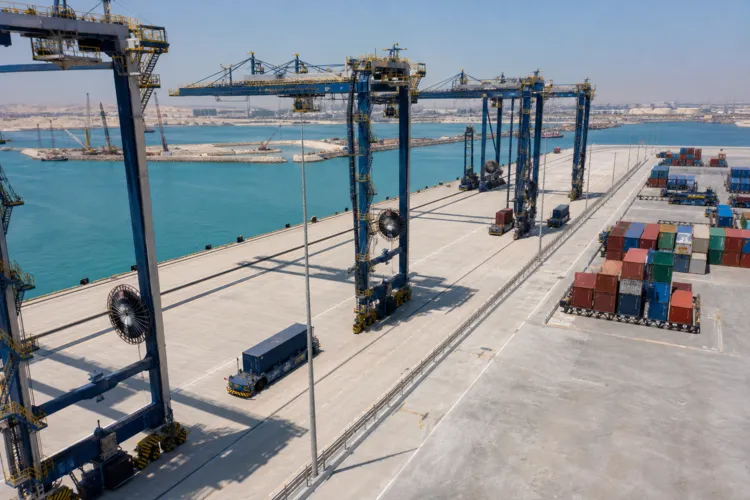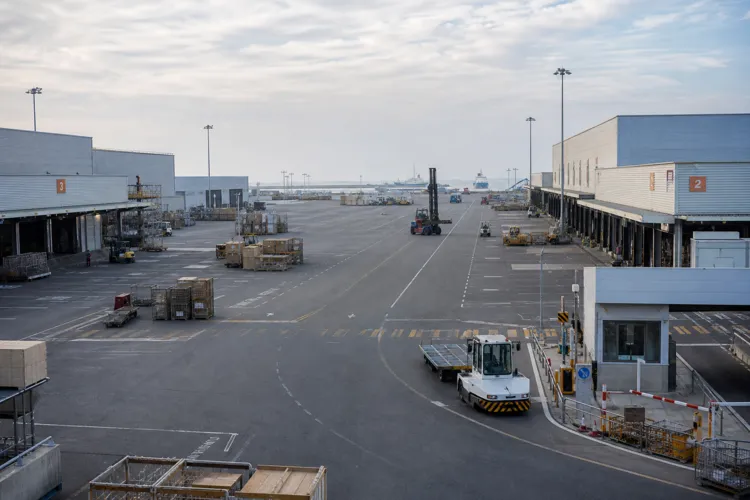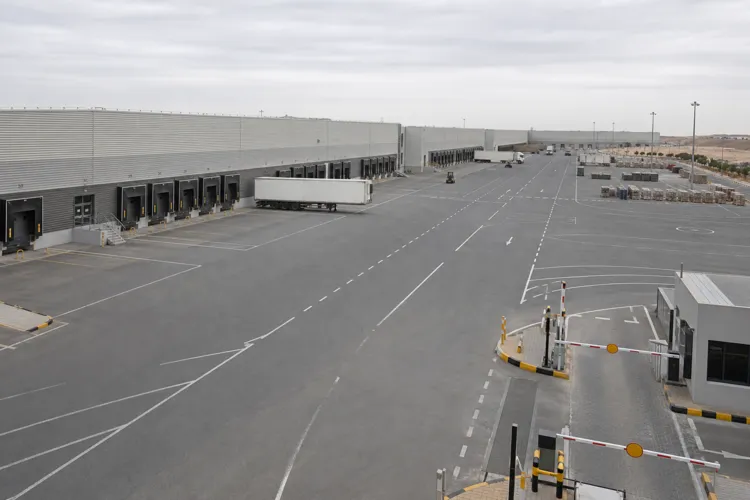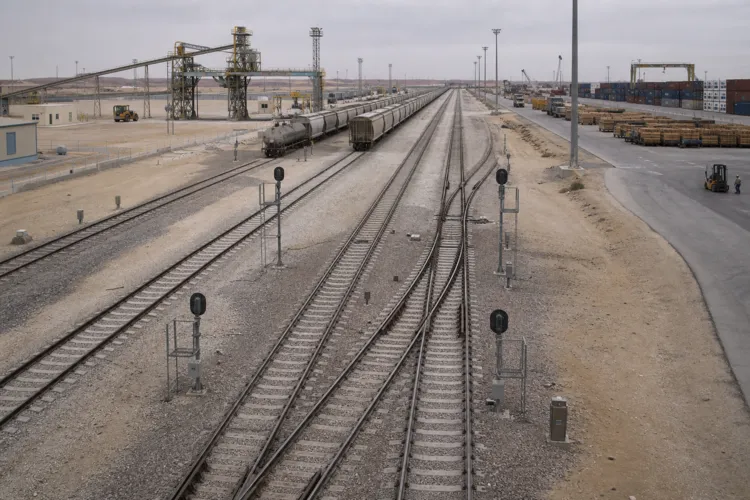
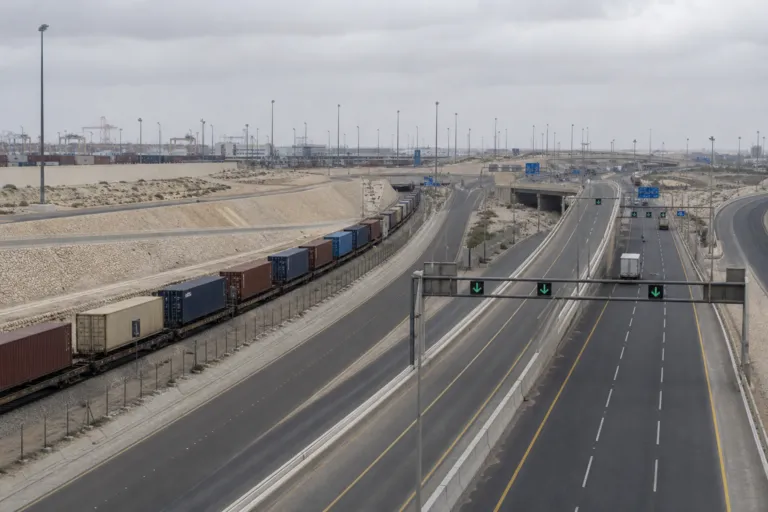
As the Strait of Hormuz blockade entered its third week, Saudi Arabia moved to turn geography into logistics capacity. On March 12, during a field visit to Jeddah Islamic Port, Minister of Transport and Logistics Services Eng. Saleh Al-Jasser announced the Western Coast Logistics Corridors Initiative. The intent was clear: establish dedicated operational pathways so commercial cargo could shift from Saudi Arabia’s eastern ports and from ports across the six GCC member states to Jeddah Islamic Port and other Red Sea facilities. That mattered because Saudi Arabia spans both the Persian Gulf and the Red Sea, and its road and rail links connect east to west, giving the Kingdom an outlet outside the conflict zone when Gulf-side ports faced the same Hormuz restrictions as regional peers.
The rerouting pressure was not theoretical. Kpler maritime intelligence reported that approximately 170 containerships with a combined capacity of around 450,000 TEU remained trapped or restricted inside the Persian Gulf. At the same time, Maersk, CMA CGM, and Hapag-Lloyd suspended Hormuz transits indefinitely, forcing cargo owners and carriers to find ways to “land” boxes elsewhere. Separate Kpler analysis two months into the crisis also framed the disruption as structural rerouting rather than a brief shock, noting that cargo flows were being redistributed and that ports absorbing diverted Gulf traffic were operating far outside historical baselines. In that environment, the Saudi corridors functioned as a pressure-release valve for containerized trade that could not wait for normal transits to resume.
From Sea Lane to Landbridge: How Diversion Worked in Practice
By May, the region looked less like a single-route system and more like a “portfolio of corridors,” with overland moves complementing alternate ports. UAE-based trucking platform Trukker said it deployed more than 500 trucks during the early days of the conflict, reporting a 30% increase in road shipments during March. IMF Portwatch data showed ship arrivals into Jebel Ali drying up through March and April as carriers and cargo owners searched for alternatives, while ports such as Jeddah on Saudi Arabia’s Red Sea coast and Oman’s Sohar and Salalah increasingly absorbed cargo flows previously routed through hubs like Jebel Ali. Shipping lines also acted more like overland logistics operators: Hapag-Lloyd established trucking corridors across Saudi, Oman, and the UAE connecting Bahrain, Kuwait, and Qatar, while Maersk and MSC rolled out similar land-based solutions.
The absorption was not limited to industrial shipments. UAE businesses and retailers shifted consumer goods and food shipments onto alternative routes, including Red Sea ports such as Jeddah. Supermarket operator Spinneys routed some shipments through Jeddah and used a mix of increased air freight and east coast UAE ports, with its general manager, commercial noting that “there are still many ships west of the Strait of Hormuz that continue to offload food.” Spinneys said it had so far absorbed higher logistics costs rather than passing them on to consumers, highlighting that the new routing patterns had immediate commercial implications. The crisis also pushed previously conceptual cross-border customs corridors toward real operational relevance, as Saudi Arabia’s initiative was described as aimed at strengthening supply chain resilience and facilitating cargo movement between the Kingdom’s ports and those across the GCC.
While the corridors solved an urgent problem, they also revealed the scale of the region’s dependence on Hormuz. As of April 8, 2026, shipping companies and insurers continued to treat the waterway as a high-risk zone even after limited maritime movement resumed under a temporary ceasefire between the United States and Iran. Middle East Briefing noted that the Strait normally handles roughly one-fifth of global oil trade and serves as the primary maritime gateway for most Gulf economies. In that context, alternative infrastructure across the GCC became a practical hedge: Construction Business News Middle East cited Mordor Intelligence expectations that the GCC freight and logistics market will grow from approximately USD 83.24 billion in 2025 to USD 120.21 billion by 2031, at a 6.12% CAGR. The Saudi Logistics Corridors Initiative fit that wider shift by turning emergency diversion into a working model for resilience.
What triggered Saudi Arabia’s emergency west-coast corridors in 2026?
How much container capacity was reported trapped or restricted inside the Persian Gulf?
What role did Jeddah play when ship arrivals into Jebel Ali declined?
How did trucking activity change during the early phase of the disruption?
How did the Saudi Logistics Corridors Initiative support GCC cargo movement?
Talk to us for your needs in:
- Identifying Suitable Warehouse Sites in Saudi Arabia
- Customized Logistics and Supply Chain Analytics
- Logistics Network Design and Optimization
- Green Supply Chain and Sustainable Logistics Solutions
- Supply Chain Risk Management and Compliance
- Advanced Supply Chain Resilience and Agility
- Logistics Market Research and Strategic Analysis
- In-Depth Market Survey for Logistics
- Market Intelligence and Insights in Logistics
- Feasibility Study and Assessment in Logistics
- Integrated Warehousing Management Solutions
- Smart Warehousing and Automation Systems
- Sustainable and Green Warehousing Practices
- Port and Airport Logistics Optimization
- Digital Logistics Solutions
- Saudi Logistics Benchmarking