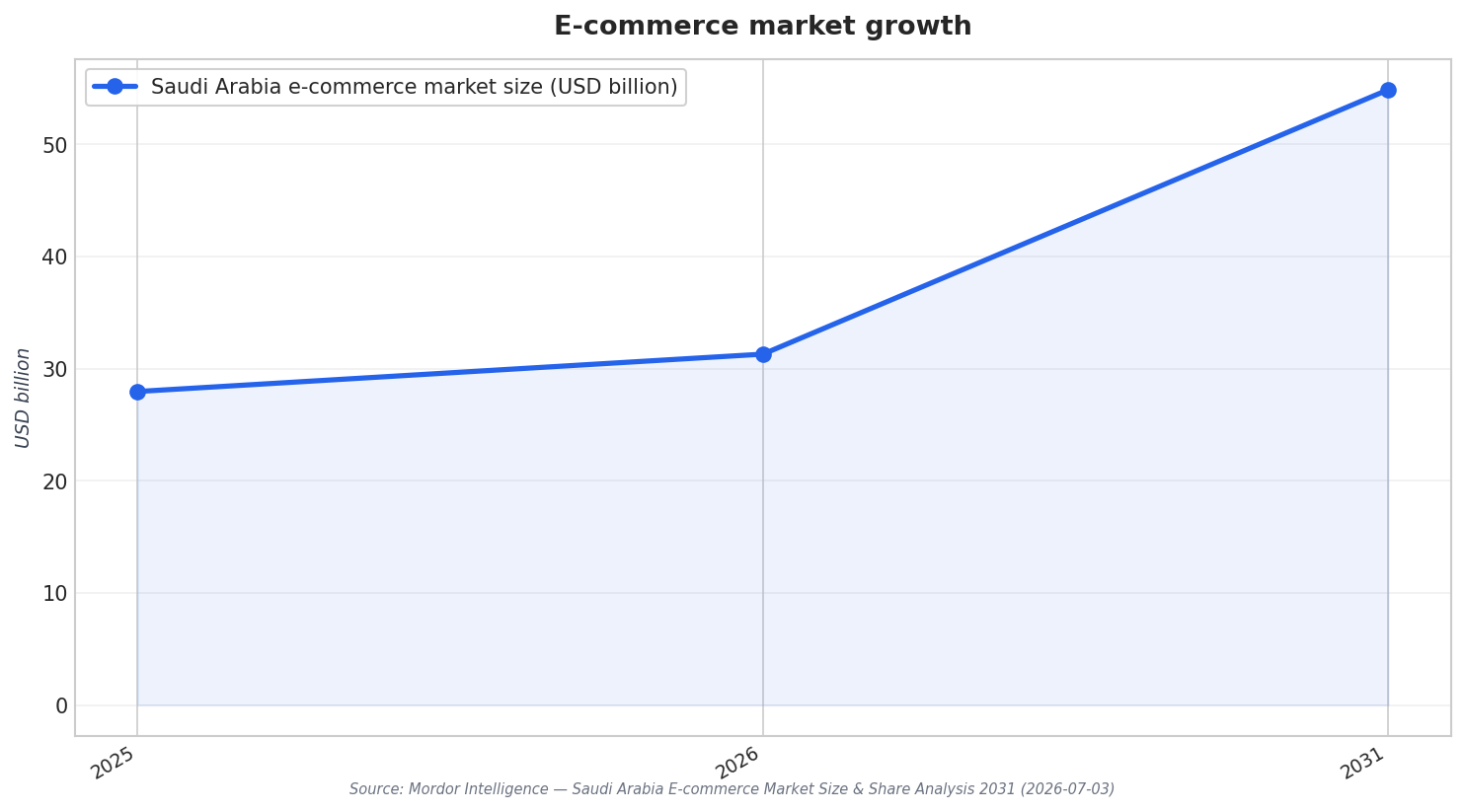
Saudi Arabia’s e-commerce momentum is pushing fulfillment teams to operate with less friction and more control. Mordor Intelligence estimates the Saudi Arabia e-commerce market at USD 31.29 billion in 2026, up from USD 27.96 billion in 2025, with projections reaching USD 54.87 billion by 2031 at an 11.92% CAGR over 2026–2031. The same source cites 99% internet penetration and 78% 5G coverage, alongside mobile-first behavior where smartphones delivered 77.98% of B2C revenue share in 2025. In this environment, API-first fulfillment becomes a practical requirement, because every handoff between storefront, warehouse, and carrier needs to happen quickly and consistently—especially as customer expectations move at mobile speed.
API-first fulfillment means designing operations so systems talk to each other by default. For Saudi 3PLs, that typically translates into order, inventory, and status updates flowing automatically between an e-commerce platform and logistics tools such as a WMS or TMS. This matters as platforms scale. Storeleads reports 23,678 live stores running on Salla today. Meanwhile, comparisons of Salla and Zid emphasize their app ecosystems and local tooling: Salla is described as having a wide library of applications and integrations, while Zid is described as integrating strongly with local tools and services in Saudi Arabia. Together, these signals point to an ecosystem where integration quality affects fulfillment speed, support load, and the merchant’s ability to expand without turning operations into spreadsheets.
Why Saudi 3PLs Are Moving Toward API-First Operations
Saudi 3PLs are also operating inside a logistics market that is growing and modernizing, but facing real execution pressure. Mordor Intelligence sizes the Saudi Arabia 3PL market at USD 13.02 billion in 2026 and projects USD 16.54 billion by 2031, a 4.91% CAGR. The same report links efficiency gains to system-level integration, noting that 3PLs integrating port APIs directly into TMS platforms gain real-time visibility and faster clearance cycles. It also notes heavy construction traffic around NEOM and Qiddiya extending urban delivery times by 25–40%, increasing operating costs through factors like night-shift premiums and micro-hub rentals. In this context, better integration is not just “nice to have.” It is one of the few levers that can reduce manual work while keeping service levels stable.
When Saudi 3PL teams plan a Salla Zid 3PL fulfillment integration, API-first thinking helps them standardize the basics: consistent order ingest, synchronized inventory, and shipment event updates that merchants can see quickly. It also supports more flexible routing choices as domestic infrastructure evolves. Mordor Intelligence notes the 1,300 km Dammam–Riyadh–Jeddah freight rail corridor is set to reduce cross-Kingdom transit times by nearly 50% and lower carbon emissions per ton-kilometer by an estimated 60–70% versus long-haul trucking. If a 3PL can expose reliable status updates back to the storefront, merchants can communicate clearer delivery expectations to mobile shoppers, where checkout and tracking experiences often define repeat purchase behavior.
API-first fulfillment also aligns with how Saudi online buying is structured today. Mordor Intelligence reports B2C transactions held 73.54% of Saudi e-commerce market share in 2025, and credit/debit cards led B2C payments with a 42.62% share that year. Riyadh contributed 35.01% revenue share in 2025, while the Eastern Province is projected to post the highest 12.76% CAGR through 2031. These patterns reinforce why operational clarity matters: high-volume B2C flows, payment success sensitivity, and region-specific demand growth all increase the cost of fulfillment errors. For 3PLs integrating with Salla and Zid, the goal is simple: fewer touchpoints, faster exceptions handling, and order-to-delivery visibility that matches an always-connected shopper base.
What does API-first fulfillment mean for Saudi 3PLs working with Salla and Zid?
How big is Saudi Arabia’s e-commerce market in 2026, according to Mordor Intelligence?
How many live stores are running on Salla?
What logistics pressures make integration more important in Saudi Arabia?
What share of Saudi B2C e-commerce revenue comes from smartphones?
Talk to us for your needs in:
- Identifying Suitable Warehouse Sites in Saudi Arabia
- Customized Logistics and Supply Chain Analytics
- Logistics Network Design and Optimization
- Green Supply Chain and Sustainable Logistics Solutions
- Supply Chain Risk Management and Compliance
- Advanced Supply Chain Resilience and Agility
- Logistics Market Research and Strategic Analysis
- In-Depth Market Survey for Logistics
- Market Intelligence and Insights in Logistics
- Feasibility Study and Assessment in Logistics
- Integrated Warehousing Management Solutions
- Smart Warehousing and Automation Systems
- Sustainable and Green Warehousing Practices
- Port and Airport Logistics Optimization
- Digital Logistics Solutions
- Saudi Logistics Benchmarking