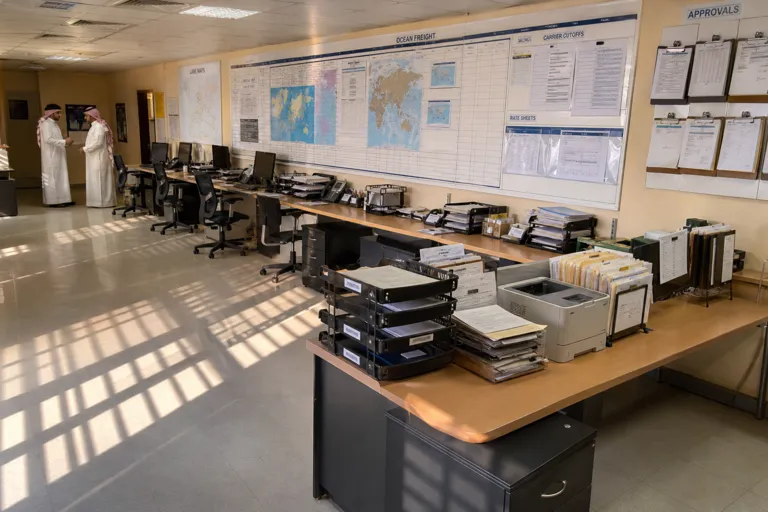
Freight forwarding still runs on documents. A single shipment can generate 8–15 pages, including bills of lading, commercial invoices, packing lists, certificates of origin, airway bills, customs declarations, and proof of delivery. When teams process these files manually, it typically takes 5 to 15 minutes per file and can produce 2 to 5% error rates. Those errors can cascade into customs holds, carrier disputes, and client escalations. In practice, this is why the topic of AI agents freight forwarding Saudi Arabia is often less about “automation for its own sake” and more about protecting service quality while reducing repetitive work.
On the documentation side, multiple sources describe measurable improvements when AI is applied to bill of lading and shipment document processing. One comparison states AI can process bills of lading 3x faster with 60% fewer errors than manual work, cutting freight document handling time from hours to minutes. The same source frames the operational impact in workload terms: a mid-sized forwarder handling 500 shipments per month may spend 40–125 hours manually extracting data from paper and PDF documents and rekeying it into a TMS, ERP, or customs platform. Tools and implementations emphasize that value depends on integration: reading documents is not enough unless the extracted fields are pushed into systems of record such as CargoWise, Magaya, SAP TM, or Oracle TMS.
Automate the Workflow, Not the Authority
Agentic systems are most useful when they separate what is confirmed from what is missing. One operations-focused framework warns that faster replies can amplify commercial risk if missing dimensions become assumed chargeable weight, or if an expired rate becomes a confirmed quotation. The recommended approach is to scope automation around the work between an enquiry, a reviewed quotation, a booking, and a consistent shipment record. That means distinguishing information supplied by the customer, information inferred by a model, and information retrieved from an approved commercial record. The result should be evidence in the operational file, not a confident-looking paragraph that hides assumptions.
Booking and quoting automation is also evolving, but control still matters. Tools in the market are described in categories such as document processing, quote automation, rate intelligence, visibility and tracking, and customs and compliance, and mature deployments often combine multiple tools. Rate and booking capabilities may come via digital marketplaces that let forwarders compare rates and book shipments, while other platforms focus on automating operational tasks such as scheduling, document generation, and carrier communication. Broader digital freight platforms combine booking, execution, documentation, and visibility in one interface, using AI to match shipments with available capacity and predict delays based on inputs like port congestion, weather, and carrier performance data.
Customs queries are a natural fit for agent workflows when they are constrained to approved steps and human approval gates. Some agent products focus on specific document and filing work, including customs entry preparation and entry audits. A real implementation example is described for a mid-sized freight-forwarding company operating across the UAE and Saudi Arabia, where the agent is designed to accept documents through channels teams already use, such as shared email inboxes, WhatsApp Business, customer portals, SFTP, cloud folders, scanners, and API feeds. The emphasis is consistent: the agent should automatically link documents to the correct shipment or booking record, and it should help teams move faster without taking over the decision-making that commits the business commercially.
How do AI agents reduce document work in Saudi freight forwarding operations?
What workload can AI document extraction remove for a mid-sized forwarder?
How can teams automate booking and quoting without losing control?
What channels can an agentic system use to collect shipment documents?
Talk to us for your needs in:
- Identifying Suitable Warehouse Sites in Saudi Arabia
- Customized Logistics and Supply Chain Analytics
- Logistics Network Design and Optimization
- Green Supply Chain and Sustainable Logistics Solutions
- Supply Chain Risk Management and Compliance
- Advanced Supply Chain Resilience and Agility
- Logistics Market Research and Strategic Analysis
- In-Depth Market Survey for Logistics
- Market Intelligence and Insights in Logistics
- Feasibility Study and Assessment in Logistics
- Integrated Warehousing Management Solutions
- Smart Warehousing and Automation Systems
- Sustainable and Green Warehousing Practices
- Port and Airport Logistics Optimization
- Digital Logistics Solutions
- Saudi Logistics Benchmarking